Showing posts with label science family. Show all posts

Monday, June 29, 2009

One of my favourites.

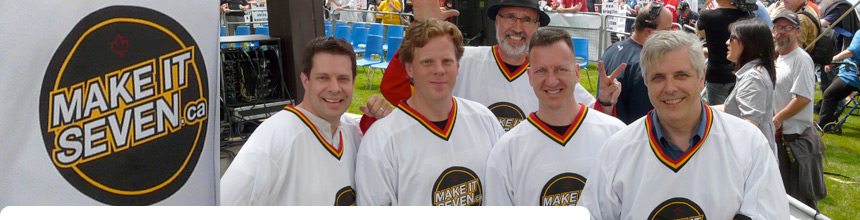
Every few days the banner on the University of Guelph website changes to show off an important event or information about the school. The most recent banner is one of my all-time favourites. It shows Doug and one of his bands, the GMO's, at the Make it Seven Rally in Hamilton. The GMO's wrote a song about the drive to bring a seventh national hockey league team to Canada and they were picked up by the rally organizers to play on the big day.

Friday, June 12, 2009

Causes and consequences of biodiversity.

This afternoon the PhD student I've worked with for the past 3 and a half years is defending his thesis. This is exciting because I've had a bit part in his field projects. My Masters project is related to his work and we've worked together ever since I started here. Basically for my entire career outside of my undergrad.

We've spent long days out in abandoned quarries and taken care of zillions of tiny little rare alvar plants. I have great memories of lunchtimes under the little birch tree at the edge of Water's Quarry and dipping our feet into the water off the boardwalk at Fletcher's Creek. Working on his projects I had the chance to visit many parts of the Niagara Escarpment I would never have had access to otherwise. We drove long hours and listened to good music. For the past year or so, we've both been writing away and preparing to present out work. He's spent a lot of time away from the lab, but he's always quick to answer e-mails and he has been tremendously helpful with my work. I know he'll make a great professor and teacher and will probably have a really cool research program too.

I'm excited to see his presentation and listen to the question period. We'll celebrate afterwards and I made a small present for him to say congratulations and thank you for everything. I'll post pictures once I've given it to him.

Everything is wrapping up in the Cliff Ecology Research Group. My thesis is finished and only needs a few changes before I can have my papers signed and set-up a defence date. I'm planning a big trip, moving, and I have about a million other things to do before all of that. I'm planning on posting all of my Halifax stuff here once I have a few free minutes. I kept a few notes while I was there and want to include that all here.

Wednesday, March 11, 2009

This Man.

The history of science is interesting and important to study. All of our modern thoughts, ideas, and conventions have important connections to the scientists that came before us. One scientist that we talk about a great deal in our lab is this man:


Nikolai Vavilov was born on November 25, 1887 in Moscow, Russia. There he graduated from the Agricultural Institute in 1910 after completing a thesis on the impact of snails on agriculture. He went on to hold many important positions in Russia where he studied botany and agriculture. He was the man who first determined the centres of origins of many of the most important agricultural species we still use today. This work relates to the work that my lab did just previous to my joining which was summarized in the book The Urban Cliff Revolution.


Vavilov collected seeds from all over the globe. He developed the largest seedbank in the world in Leningrad. During the Siege of Leningrad, which lasted from 9 September 1941, to 18 January 1943, Vavilov's research assistants defended the seed collection. As Hitler tried to gain power over the Soviet Union people were dying from starvation, but the edible seeds and potatoes survived for prosperity. Even one of the research assistants starved to death during that time.

Vavilov, himself, was arrested in 1940 for repeatedly criticizing the non-Mendelian concepts of his one time friend and Stalin's protege, Trofim Lysenko. Vavilov died in the German prison in 1943 due to malnutrition, but the entire time he was there he delivered over 100 scientific lectures.

In studying modern agriculture and botany we follow in everything Vavilov laid out for us. The Vavilov Institute of Plant Industry stills maintains one of the largest seedbanks in the world.

The Decemberist's last album, The Crane Wife memorializes Vavilov in one of their songs, When the War Came. His story is tragic, but inspiring at the same time. Every time we talk about Vavilov in the lab or find out new information about his life traveling the world and doing good science we end up laughing and smiling. He would have fit in very well here because, as Doug says, Vavilov captures what is good in all of the best scientists we've known.

Tuesday, January 20, 2009

Knit Digestive System.

I actually came across the knit brain from the previous post at a crafty forum I read sometimes. The people there find all kinds of fantastic projects and items. This completely knit digestive system came up in the same thread as the brain. I'm going to keep an eye on this one.


The first Fibonacci legwarmer was finished just after knit group last night. The second was cast on today. It's slow going because the wool is fine and the entire thing is ribbed for extra stretch. Next up in my knitting bag is the fourth self-striping sock since Christmas (I had to take a break before I finished the last one...fourth sock syndrome, anyone?). Self-striping wool is a mathematical achievement in itself. One of my favourite bloggers, Eunny Jang of See Eunny Knit has a great tutorial for home dyeing.

Okay, I'm out. I've been doing some research on my science family so I'll try to update that tomorrow.

Cass

Thursday, January 15, 2009

An extra little side project.

My advisor is nearing retirement. He spends a lot of time working on projects that he has wanted to do for much of his academic career. He just does a lot of crazy and interesting things in general, but one of my favourite projects of his is a screenplay he is creating about a scientist who died for his beliefs. I won't give much more away, but to say that I am endlessly inspired by the creativity of the people I work with. They have had a big influence on helping me decide on the directions I am hoping/wanting to take over the next few years.

The other day a past student came into the lab to chat with Doug about life in general, it seems. Doug wasn't in, so she asked me about my work and the grad student lifestyle. We had a good chat and Doug showed up. I tried to focus on the analysis I had been working on, but in our lab it is impossible to stay entirely out of a conversation. Since I was sitting just down the lab bench Doug was using my experiences in the lab as examples of how one goes about securing a grad studies position. Doug loves to compare the committment of a Masters student to the committment of a partner in marriage. In his words, if you're entering grad school you are marrying your project. In my mind, it's a short-term marriage lasting on average 2 years sometimes including an extended period at the end were you just keep dragging things out and dragging things out until you just have to split because you can't take it anymore. Just dump yourself, already. heh. That being said, I know what he's getting at. To be successful in grad school you need to trust your instincts, dive in head first, dedicate yourself to your work, love what you're doing (ha - at the analogy, of course...I love my work), and accept that this will change you, generally for the better (there are always exceptions to the rule). Anyway, on this particular day, Doug took this analogy to another level. He started talking about me as the scientist kid. He is my scientist father, his advisor is my scientist grand-father, and so forth back to the days of my old, affluent, white-men scientist forefathers.

This idea really caught my attention.

So, aside from figuring myself out, I'm going to use this space to develop my scientific family tree. I have a feeling that this will be much easier than regular family-tree making. I won't have any gravestones to take rubbings from and universities are very good record keepers.

So to start out, let me introduce you to my scientific immediate family: The Cliff Ecology Research Group. I've got nothing but love for these ones.

Cass